The Phosphorus Hiding in My Groceries (And Why the Label Never Told Me)
I've been on dialysis long enough to think I had the food part figured out.
I read labels. I knew my numbers. Then I spent twenty minutes standing in a supermarket aisle realizing that something I'd been doing carefully for months had a hole in it big enough to drive a truck through.
I should say where I was standing, because it matters for what follows. I live in Portugal and do my shopping here. Most of the people who read this are in the United States. When I found the hole, my first thought was that it was a European problem — so I went and checked the American rules too.
It isn't a European problem. It's the same hole in both places. The only thing that changes is what it looks like on the package.
Neither label has to tell you
In the United States, phosphorus is not required on the Nutrition Facts panel. A manufacturer can list it voluntarily. Most don't.
In the European Union, the mandatory nutrition declaration is seven items: energy, fat, saturates, carbohydrate, sugars, protein and salt. Phosphorus isn't one of them either.
Sodium is there. Protein is there. Phosphorus — the number half my diet is organized around — is optional on two continents.
So when I stood there comparing two packs of frango, both of them told me nothing about the thing I most needed to know. Not because anyone was hiding it. Because nobody is required to say it.
The part that actually matters
It gets worse, and this is the piece I wish someone had explained on day one.
Not all phosphorus behaves the same way in your body.
The phosphorus that occurs naturally in food — in beans, in whole grains, in nuts — is bound up in forms we absorb poorly. Roughly half of it, often less, actually reaches your bloodstream. Your body does you a favor.
The phosphorus in additives is a different animal. These are inorganic salts, already in exactly the form your gut is ready to take. Absorption runs close to complete.
So two foods can carry the same number on paper and land completely differently in your labs. A bowl of lentils and a marinated chicken breast are not the same event, even if a database says both have 300 mg.
That's what got me. I'd been treating phosphorus as one number. It's two.
How to spot it — the same trick, two alphabets
The nutrition panel failed me. The ingredient list didn't. Additives have to be declared, and once you know the shape of them they're hard to miss.
If you're reading a US label, look for four letters: PHOS.
- sodium phosphate
- phosphoric acid
- sodium tripolyphosphate
- sodium hexametaphosphate
- tetrasodium pyrophosphate
- dicalcium phosphate
If you're reading an EU label, the same additives appear as E-numbers, and there are eight worth memorizing:
| E-number | What it is |
|---|---|
| E338 | Phosphoric acid |
| E339 | Sodium phosphates |
| E340 | Potassium phosphates |
| E341 | Calcium phosphates |
| E343 | Magnesium phosphates |
| E450 | Diphosphates |
| E451 | Triphosphates |
| E452 | Polyphosphates |
Anything from E338 to E452 in that range is phosphate. Portuguese labels often print the function next to it — estabilizador, emulsionante, regulador de acidez — which tells you what it's doing but not what it costs you.
I check the ingredient list before I check anything else now. Three seconds, and it's the highest-value habit I've picked up since starting dialysis.
Where I keep finding it
Some of this is universal, some of it depends on which supermarket you're standing in.
Everywhere:
- Deli and processed meat. In the US, sliced turkey and ham. Here, fiambre — and I have yet to find one without E450 or E451.
- Colas and some flavored drinks. Phosphoric acid is right in the name.
- Processed cheese and spreadable cheese. What makes it melt smoothly is usually phosphate.
- Non-dairy creamers, instant products, some breads.
Mostly a US thing: "enhanced" or "marinated" fresh chicken — look for contains up to X% solution on the pack. That solution is salt and phosphates. Plain chicken doesn't have it. Same meat case, same price bracket, very different result.
Mostly a Portugal thing: the pré-temperado and marinated trays in the fresh section, and almost anything in the charcutaria case. Plain chicken and plain fish are still plain. The convenience is where the phosphates live.
Fresh, single-ingredient food mostly doesn't have this problem. That's not a coincidence, and it's not a coincidence that it's also what every renal dietitian has been saying all along — the guidelines my targets come from are listed on the medical sources page.
Where the app came in
I built renalee because I got tired of doing this math standing in an aisle with a phone in one hand and a package in the other.
I photograph the food. It gives me potassium, phosphorus, sodium and protein — the four numbers I actually care about, not calories. The food photo analysis page explains what actually happens between the photograph and the diary entry.
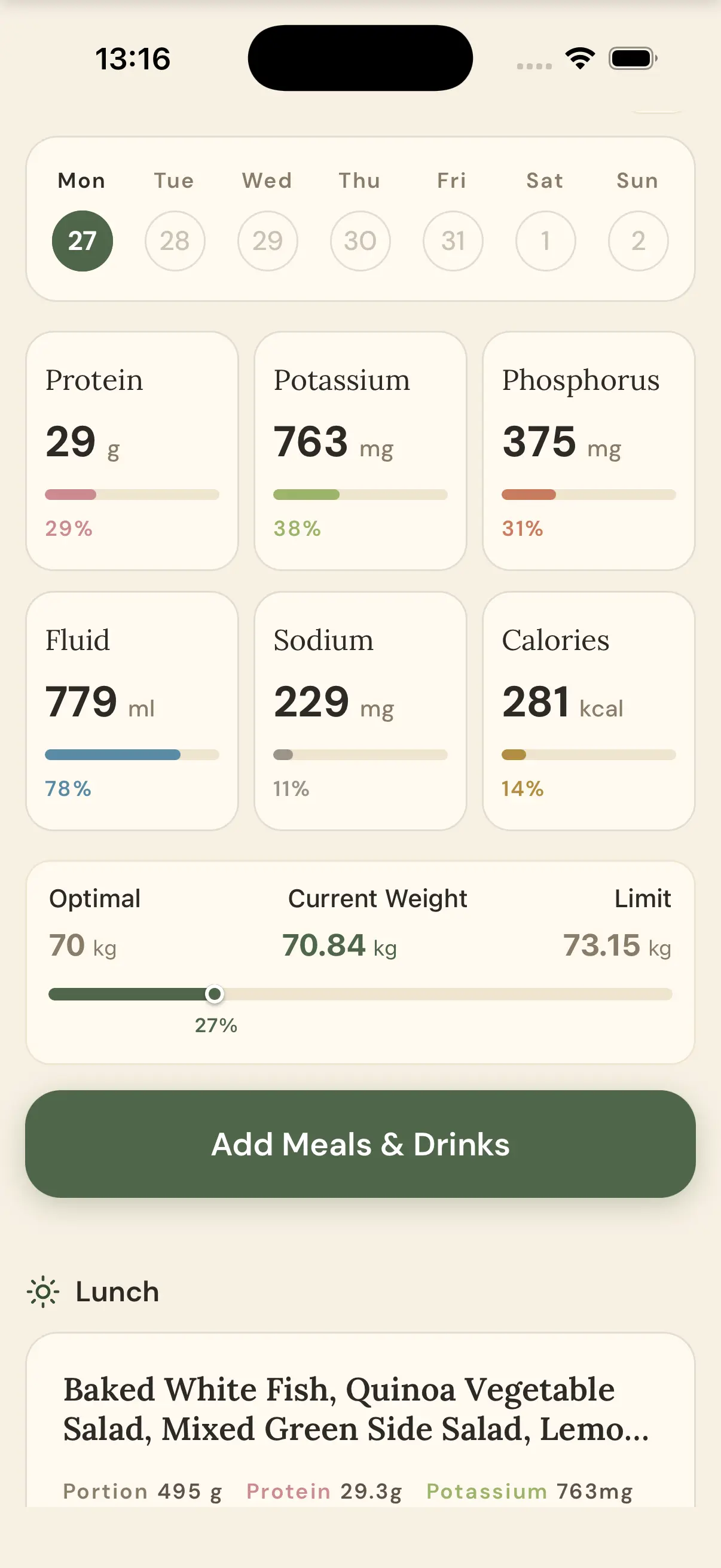
I'm not going to pretend an app fixed my labs. What it fixed was consistency. Before, I did this well on the days I had energy and badly on the days I didn't — and on dialysis, the days you don't have energy are not rare. Now it's the same thirty seconds whether it's a good week or a bad one.
That's the whole thing, honestly. Not knowledge. Discipline on the bad days.
If you take one thing from this
Turn the package over. Skip the nutrition panel for a moment and read the ingredients.
In the US, look for PHOS. In Europe, look for E338 through E452.
You'll find it in things you didn't expect. I did.
This is my personal experience, not medical advice. I'm not a doctor or a dietitian. Your phosphorus targets, your binders and your diet belong to your nephrologist and renal dietitian — please take anything here to them before you change what you're doing.
Track the four numbers that matter
renalee estimates potassium, phosphorus, sodium and protein from a photo of your meal, and keeps the running daily total.